2013年8月14日星期三

Apple, Watch Out: Xiaomi Has Overtaken You In China

At noon on August 12, Xiaomi Tech’s latest smartphone goes on sale in China.  Priced at just 799 yuan ($130), the Android-powered Hongmi, or “Red Rice,” is expected to be this year’s smash. 
Even without the Hongmi, Xiaomi sells more smartphones than Apple AAPL +1.85% in China.  The Canalys Q2 rankings put the Cupertino-based company in seventh place with 4.8% of the Chinese market.  Xiaomi, which means “Small Rice,” is one notch above with 5.0%. 
Apple may be just a shade behind Xiaomi in China, but it is miles from Samsung, which sold 17.6% of the smartphones there last quarter to take the top ranking.  Four domestic companies—Lenovo, Yulong, ZTE , and Huawei—ended up in spots two to five.
Lagging behind in China makes a difference.  More than a third of the world’s smartphones were sold there last quarter, according to Canalys, and Apple is sinking fast in that market, losing almost half its share in a year.  Its fans are waiting for the successor to the iPhone 5, but even a hit will not make much difference for a high-end company in China’s increasingly low-end market. 
Yet Apple’s China problems go well beyond being trapped in the saturated top segment of the market, so the budget iPhone, rumored to be in the works, may not do well in that country.  For one thing, the iconic company is losing the “cool factor” there, and introducing a budget phone, which is thought to be designated the iPhone 6, will not help a fading image.  As Gartner’s Sandy Shen and others have pointed out, competing in the bottom of the market is “a self-acknowledgement” that Apple now is just another phone manufacturer. 
As Apple continues on the road from “absolutely must have” to “boring,” its new budget phone will have to compete on price.  Yet Xiaomi is getting the hang of manufacturing for the mass market and will be an even more ferocious competitor in the segment Apple needs to enter.  At this stage, there is little Apple can do to cut costs as its third-party contractors in China, notably Foxconn and Pegatron, are under intense international pressure forallegations of illegal and unsavory practices, like the use of child labor.  Manufacturers for China’s domestic brands, on the other hand, do not attract as much scrutiny.
Apple has more than a cost disadvantage to contend with.  The company’s stand-alone marketing strategy is out-of-synch with the times.  Its eight stores in China are gorgeous, but there are not nearly enough of them for a country the size of the U.S.  The company lacks cross-promotional partnerships in China while competitors are linking up with social sites, a craze in Chinese phone marketing at the moment.  Xiaomi, for instance, has a deal to sell the Hongmi on QZone, Tencent’s social network.  With 712 million registered users, it is China’s largest social site.
There are, of course, risks for phone makers when they partner up.  For instance, Xiaomi will be shut out of QZone’s rival, Sina Weibo, the popular Twitter-like service.  Yet there is little arguing with Xiaomi’s extraordinary success.  Formed in 2010 in Beijing, it sold its first smartphone in September 2011.  Last year, it had sales of 7.2 million.  This year, chief executive Lei Junpredicts his “small and beautiful company” will sell 15 million of them. 
An amazing replacement for the iPhone 5 could change the buzz about Apple in China—as it would most everywhere else.  Yet the next offering, the iPhone 5S with a convex fingerprint sensor, does not look like it will be a game-changer when it hits the stores, apparently sometime in the latter part of September. 
Even a big success should not deter the executives in Cupertino from rethinking their strategy for China and coming up with a mid- to low-end phone.  China, after all, is a big enough market for a company like Apple to sell in multiple segments at the same time.  If it does not challenge Xiaomi in its home market—the world’s largest—it will eventually have to do so closer to home.
Today, Xiaomi sells only in two countries, China and Taiwan.  Yet as it builds up experience, cash, and confidence, it will not hesitate to go after competitors abroad, and it is in fact thinking of selling elsewhere beginning next year. 
When Xiaomi expands, it will be following other Chinese companies.  Yulong, third place in China, already sells its Coolpad smartphone in the U.S. 
And which company is the fastest-growing in the mobile phone market in America?  That would be ZTE, with 85.7% growth in the U.S. in the first quarter over the same period in 2012.  That puts the Shenzhen-based business in either third or fourth place in America, depending on the survey. 
While Cupertino execs need to look over their shoulder at the advancing Chinese, they also should think about the past, especially General Motors ceding the low-margin compact segment to Toyota.  Yes, there are reasons for Apple to protect its profitability and shun the bottom of the Chinese market, but the company must realize that GM has never fully recovered from its fundamental mistake. 
Corollas do not prevent Toyota from offering Lexus models.  That’s the lesson Apple needs to learn now—and learn quickly.  Xiaomi, in sixth place in China, is not about to give seventh-ranked Apple time to catch up. 

2013年8月12日星期一

How to Successfully Access Facebook in China

If you’re planning a visit to China and intending to share all your exciting activities and photos with your friends on Facebook – beware. The Chinese government blocks Facebook. But don’t give up. There are ways to access Facebook in China. Read on for details…

Realize that you cannot access Facebook in China directly. This is an important step that will save you a lot of heartache and frustration. It's not your computer, it's not your account. It's country-wide and it's not personal. So just get on with finding a solution.

  1. Try a proxy. A proxy is a website, often based in a different location than you, that will let you access other sites through it. So if your proxy is in the USA, and you access Facebook through it, it should be like accessing Facebook in the USA. Here's a list of free proxies:http://hidemyass.com/proxy-list/. You should for sure try them first, because why pay - but you may find they're not a great solution to access Facebook in China because 1) China keeps finding and blocking them too 2) they often don't have good enough programming to handle the technology of social media

  2. 3
    Try a secure proxy. The one I've used which works well for Facebook and other social media is Proxy Center ( https://www.proxy-center.com ). They have a free trial so you can make sure that it will work for you before you pay anything, or even give them your email. Benefit of a proxy like this (as opposed to a VPN, which we'll talk about in the next step) is that there's nothing to install on your computer - it's all web-based.

  3. 4
    Try a VPN. This stands for Virtual Private Network, and it's like putting your whole computer in a different country. The benefit of a VPN is that it affects your whole computer, meaning any internet based programs, like Skype, and not just websites. If you decide to go this route, do research and shop around.

  4. 5
    Try TOR. it can encrypt your communication to the world. It is not as easy as the options above and requires you to install a software on your computer but if you are not afraid of technology, you should give it a try.

  5. 6
    Enjoy sharing with your friends with your newfound access to Facebook in China!


Chinese Social Media: in China it is not about Facebook

Recent research from Global Web Index into global social media usage revealed some interesting results. The first that Google+ is actually the second largest global media property by penetration on active users (you don’t need me to tell you that Facebook is the first). The second is that 6 out of the top 10 are Chinese Social Media sites.
Given that China has the world’s biggest internet population and that many of the global sites including Twitter, Facebook and YouTube are banned there, it’s not surprising that they have local alternatives and the size and popularity of these sites makes them highly relevant and interesting for any business trying to reach Chinese netizens.
So which are the sites you should know about? This is a guide to the top Chinese social media platforms

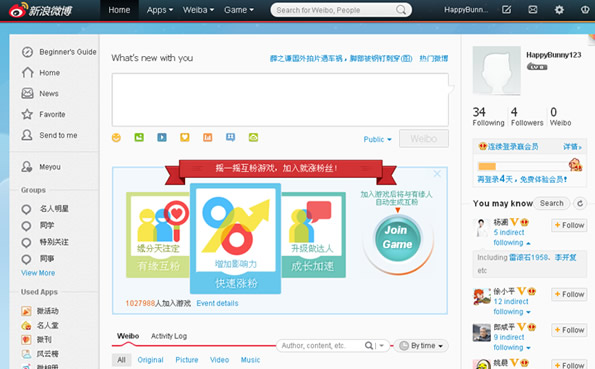
Sina Weibo

Sina Weibo (Weibo means microblog in Chinese) is a hugely popular Chinese Social Media site. It works the same way as Twitter, with similar features like the use of the @ and hashtag (#) and users choosing who to follow. Like Twitter, Sina Weibo has a 140 character limit but as these generally correspond to syllables rather than single letters like in Latin alphabets, Chinese microblog posts can generally contain more words than Twitter posts in Latin languages. Organisations can also advertise using promoted posts. The user demographics of Sina Weibo show that its users are generally white collar workers based in the major cities, making it a particularly appealing audience for advertisers. It’s also used by a number of high profile celebrities both in China and from overseas.
Chinese Social Media site Sina Weibo

Tencent

Tencent is the leading internet portal in China and biggest Chinese internet company by revenue. It has a wide range of products, one of the most popular being the QQ messenger service. It also plays a huge rol in Chinese Social Media.
Tencent Weibo
Tencent Weibo is a microblogging service, similar to Sina Weibo. It has around 540 million registed users however the user base is more focused around the poorer cities, making it less appealing to many international businesses.
Chinese Social Media site Tencent Weibo
Qzone
Qzone is China’s biggest social network and the country’s most popular site for social sharing. Talk about Chinese Social Media and you cannot miss Qzone. It has around 600 million registered users and was one of the first networks to be introduced to the market. It started life as more of a blog, developing into a social network giving it a focus on page customisation and personal expression. This is interesting for brands, who can develop branded and innovative profiles and pages on the network – even able to create their own microsites. It has a mass market appeal, reaching beyond the big cities to more remote users.

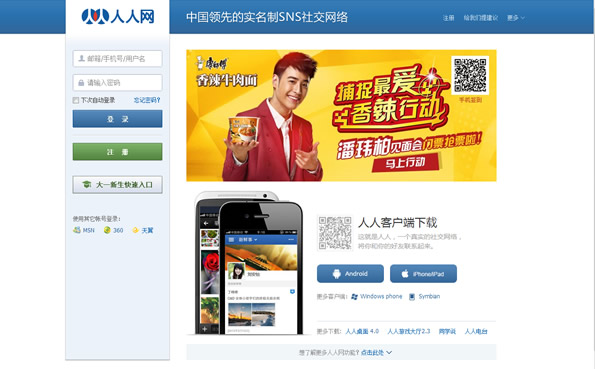
RenRen

At first glance, you could be forgiven for thinking RenRen is connected to Facebook as it looks very similar in layout and colours. This Chinese Social Media equivalent of Facebook also has many of the same features, such as the recently introduced timeline. It has fewer users than Qzone and Sina Weibo, but still can claim around 137 million registered accounts. RenRen also started out in much the same vein as Facebook – a college network – resulting in its main demographic being college students and graduates, although it is making efforts to widen its appeal. RenRen does not only own a social network, and has a range of other products and currently generates more of its revenue from online games than social advertising.
Chinese Social Media site RenRen

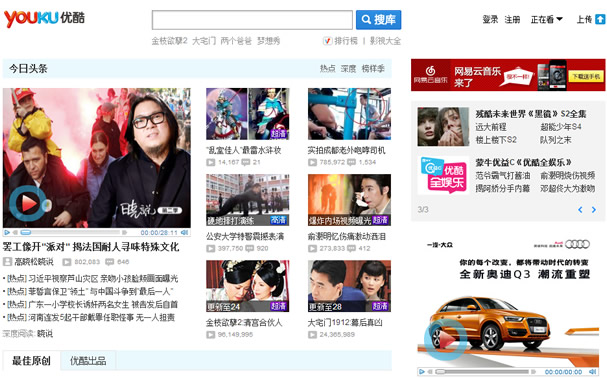
Youku Tudou

Youku and Tudou were two separate Chinese video sharing sites but in March 2012 they merged to create the largest video site in the country. They both allow users to upload content, both long and short videos. And they have over 1500 content partnerships with organisations who licence professionally produced videos. Users can view Western TV shows and films, which can’t be shown on Youtube because of copyright (which doesn’t always exist (or isn’t enforced in China).
Chinese Social Media site Youku Tudou

One to Watch – Baidu

Baidu has the Chinese search market pretty well sewn up but has been less successful in the social space, even shutting down its own microblogging service in 2011. However it seems it is taking video quite seriously having bought two video platforms – iqiyi and recently pps (for $370 million). The combined platforms will create the largest mobile platform for online video, focusing mainly on professionally produced content – which will undoubtedly start to appear in Baidu search and mobile results.

Ready to target the Chinese Social Media?

There is definitely huge opportunities for international businesses using social media to reach a Chinese audience. It is possible to register accounts for all of the sites from outside China and for non-Chinese businesses, however only Tencent Weibo has a full English interface, with Sina Weibo offering a partial English version. This makes it pretty challenging to set up accounts without using a Chinese speaker – although as all of the content you post would need to be in Chinese to reach the majority of users, there is little point in embarking on a Chinese Social Media campaign without in-house or agency Chinese resources.
Social Media management tool Hootsuite has also recognised the opportunities in China and has integrated Sina Weibo, RenRen and most recently into its interface, enabling users to manage those platforms from their Hootsuite account.
All sites are subject to China’s strict censorship laws, so all content must follow the guidelines on what is allowed to be published – otherwise it’s likely that your account will be suspended or permanently removed.
So the audience is out there, the channels to reach it are plentiful…… what are you waiting for? Chinese Social Media is waiting for you!

Chinese Social Media: in China it is not about Facebook

Recent research from Global Web Index into global social media usage revealed some interesting results. The first that Google+ is actually the second largest global media property by penetration on active users (you don’t need me to tell you that Facebook is the first). The second is that 6 out of the top 10 are Chinese Social Media sites.
Given that China has the world’s biggest internet population and that many of the global sites including Twitter, Facebook and YouTube are banned there, it’s not surprising that they have local alternatives and the size and popularity of these sites makes them highly relevant and interesting for any business trying to reach Chinese netizens.
So which are the sites you should know about? This is a guide to the top Chinese social media platforms

Sina Weibo

Sina Weibo (Weibo means microblog in Chinese) is a hugely popular Chinese Social Media site. It works the same way as Twitter, with similar features like the use of the @ and hashtag (#) and users choosing who to follow. Like Twitter, Sina Weibo has a 140 character limit but as these generally correspond to syllables rather than single letters like in Latin alphabets, Chinese microblog posts can generally contain more words than Twitter posts in Latin languages. Organisations can also advertise using promoted posts. The user demographics of Sina Weibo show that its users are generally white collar workers based in the major cities, making it a particularly appealing audience for advertisers. It’s also used by a number of high profile celebrities both in China and from overseas.
Chinese Social Media site Sina Weibo

Tencent

Tencent is the leading internet portal in China and biggest Chinese internet company by revenue. It has a wide range of products, one of the most popular being the QQ messenger service. It also plays a huge rol in Chinese Social Media.
Tencent Weibo
Tencent Weibo is a microblogging service, similar to Sina Weibo. It has around 540 million registed users however the user base is more focused around the poorer cities, making it less appealing to many international businesses.
Chinese Social Media site Tencent Weibo
Qzone
Qzone is China’s biggest social network and the country’s most popular site for social sharing. Talk about Chinese Social Media and you cannot miss Qzone. It has around 600 million registered users and was one of the first networks to be introduced to the market. It started life as more of a blog, developing into a social network giving it a focus on page customisation and personal expression. This is interesting for brands, who can develop branded and innovative profiles and pages on the network – even able to create their own microsites. It has a mass market appeal, reaching beyond the big cities to more remote users.

RenRen

At first glance, you could be forgiven for thinking RenRen is connected to Facebook as it looks very similar in layout and colours. This Chinese Social Media equivalent of Facebook also has many of the same features, such as the recently introduced timeline. It has fewer users than Qzone and Sina Weibo, but still can claim around 137 million registered accounts. RenRen also started out in much the same vein as Facebook – a college network – resulting in its main demographic being college students and graduates, although it is making efforts to widen its appeal. RenRen does not only own a social network, and has a range of other products and currently generates more of its revenue from online games than social advertising.
Chinese Social Media site RenRen

Youku Tudou

Youku and Tudou were two separate Chinese video sharing sites but in March 2012 they merged to create the largest video site in the country. They both allow users to upload content, both long and short videos. And they have over 1500 content partnerships with organisations who licence professionally produced videos. Users can view Western TV shows and films, which can’t be shown on Youtube because of copyright (which doesn’t always exist (or isn’t enforced in China).
Chinese Social Media site Youku Tudou

One to Watch – Baidu

Baidu has the Chinese search market pretty well sewn up but has been less successful in the social space, even shutting down its own microblogging service in 2011. However it seems it is taking video quite seriously having bought two video platforms – iqiyi and recently pps (for $370 million). The combined platforms will create the largest mobile platform for online video, focusing mainly on professionally produced content – which will undoubtedly start to appear in Baidu search and mobile results.

Ready to target the Chinese Social Media?

There is definitely huge opportunities for international businesses using social media to reach a Chinese audience. It is possible to register accounts for all of the sites from outside China and for non-Chinese businesses, however only Tencent Weibo has a full English interface, with Sina Weibo offering a partial English version. This makes it pretty challenging to set up accounts without using a Chinese speaker – although as all of the content you post would need to be in Chinese to reach the majority of users, there is little point in embarking on a Chinese Social Media campaign without in-house or agency Chinese resources.
Social Media management tool Hootsuite has also recognised the opportunities in China and has integrated Sina Weibo, RenRen and most recently into its interface, enabling users to manage those platforms from their Hootsuite account.
All sites are subject to China’s strict censorship laws, so all content must follow the guidelines on what is allowed to be published – otherwise it’s likely that your account will be suspended or permanently removed.
So the audience is out there, the channels to reach it are plentiful…… what are you waiting for? Chinese Social Media is waiting for you!

2013 Comprehensive China social media landscape.

CIC released their newly updated China social media landscape chart detailing China’s many players across each segment. Among all the players in this field, WeChat, the emerging mobile social APP WeChat by Tecent Group, has been stealing the thunder from Weibo with its quickly increased user number around the globe. (300 million user by the first quarter of 2013, which is no far away from Weibo, which has over 400 million registered users. )

Top 25 Most Popular Western Celebrities on China Social Media.


The world’s most powerful celebrities on top China social media sites performance, based on Renren, Sina weibo, Tencent weibo, Youku and more. 34% of the top 50 most buzzed-about celebrities in China are musicians. Almost 1/4 of the top 50 are athletes, sports include: basketball, U.S. football, soccer, boxing, tennis and golf(from Synthesio)

Top 10 most popular China social media networks.

597 Million the estimated number of active social networking users in China. The volume of social sharing in China went up by 60% in 2012. 
Top 10 Social networking sites in China: Qzone, Tencent Weibo, Sina Weibo, Wechat, Pengyou, 51.com, Renren, Douban, Kaixin001, Jiayuan. In China, 91% of the online population has an account on a social media site, as compared to 67% in the USA. 88% of Chinese social media users are active on at least one social network.
An average online user in China at least 46 minutes on social networking sites every day. Only 38% of Chinese netizens reveal their real names on social networking sites. On average, each of China’s social media user follows at least 8 brands. 43% of Chinese netizens are interested in products shared by friends on social networking sites. 38% of Chinese netizens take shopping decisions based on recommendations on their social networks. (from Go-Globe.com)